






Types of Plastic Bags: Materials, Seals and the Machines That Make Them


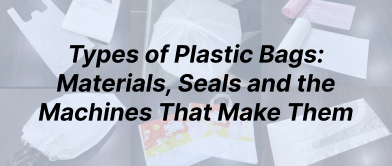
The main types of plastic bags are T-shirt bags, garbage bags, bags on roll, wicket and wave-top bags, side-seal handle bags, industrial bags and air column bags. Related disposables such as gloves and aprons are made from similar polyethylene (PE) film on dedicated machines.
Seal method is often the most practical way to tell them apart. It shapes how the bag opens and fills, where it is most likely to leak and which type of machine can produce it. For anyone planning a new bag line, it is also the first decision that narrows down the machine choice, before bag size, film thickness and output.
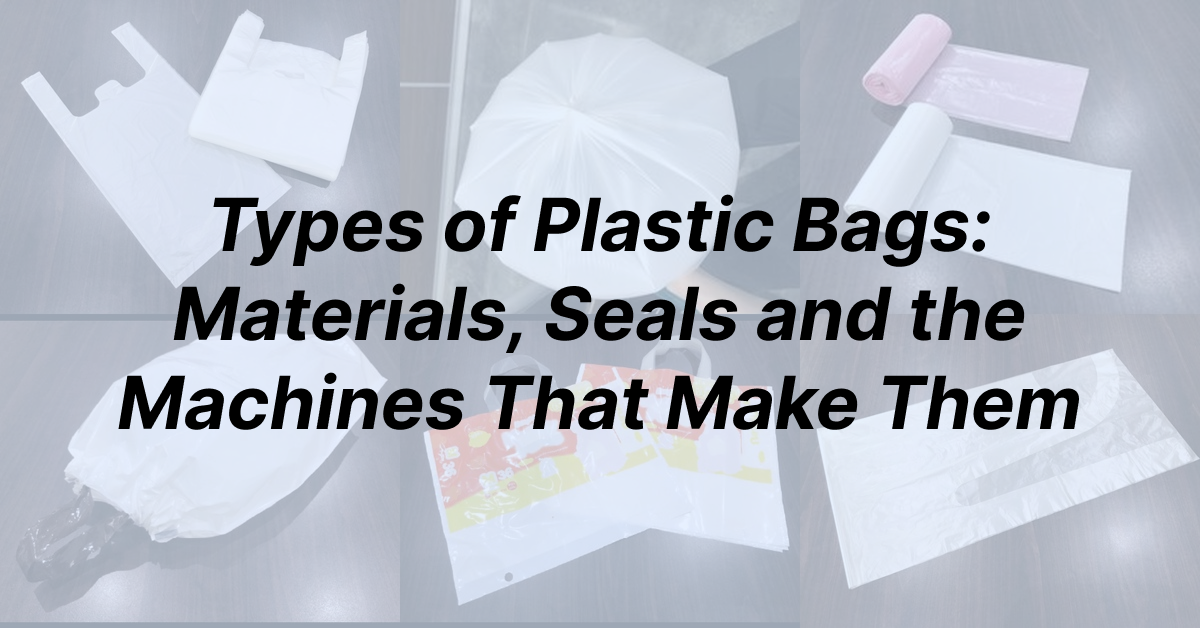
Quick Answer: Bag Type, Material, Seal and Machine
| Bag type | Typical material | Seal method | Typical use | COSMO machine category |
|---|---|---|---|---|
| T-shirt / vest bags | HDPE, LDPE, LLDPE | Bottom seal + handle punch | Supermarket & retail checkout | T-shirt Bag Making Machines |
| Flat bottom-seal garbage bags | LDPE, HDPE | Bottom seal | Household & office bin liners | Bottom Sealing Bag Making Machines |
| Star-seal garbage bags | HDPE, LLDPE | Star seal | Round bin liners, janitorial waste | Bags on Roll Making Machines |
| S-shape / folded garbage bags | LDPE, HDPE | Bottom seal; 3- or 4-fold, or S-shape (SOSR-1000-R also makes S-shape bags on roll) | Household and commercial bin liners | Bottom Sealing Bag Making Machines |
| Bags on roll (produce/food) | HDPE, LDPE | Bottom or star seal, perforated | Produce, bakery, deli | Bags on Roll Making Machines |
| Wicket bags | LDPE, HDPE | Side seal with wicket holes (saddle bags run on the same SSD line) | Bread, hardware, dispenser racks | Side Sealing Bag Making Machines |
| Wave-top carry-out bags & cup carriers | HDPE, LDPE | Side seal | Takeaway food & drinks | Side Sealing Bag Making Machines |
| Side-seal bags (loop handle, die-cut handle, draw tape, patch handle) | LDPE, HDPE | Side seal | Retail carriers; diaper bags on SH-1000DP | Side Sealing Bag Making Machines |
| Industrial bottom-seal bags | LDPE, HDPE | Bottom seal | Construction, jumbo liners | Bottom Sealing Bag Making Machines |
| Disposable gloves | PE film (HDPE/LDPE) | Melting cut-off (no cutting knife) | Food service, light industrial | Disposable Plastic Product Making Machines |
| Disposable aprons | PE film (HDPE, LDPE) | — | Food service, cleaning | Disposable Plastic Product Making Machines |
| Air column bags | PE film | Heat-sealed to mold pattern | Void-fill & product cushioning | Disposable Plastic Product Making Machines |
Types of Plastic Bags by Material
Most plastic bags use a PE or polypropylene (PP) film grade. The grade affects seal temperature, stretch and feel, not just cost.
- HDPE (high-density polyethylene, resin code #2): stiff, semi-opaque and strong; the usual film for grocery and retail T-shirt bags.
- LDPE (low-density polyethylene, resin code #4): softer and more flexible than HDPE; common in bread, produce and newspaper bags, plus bin liners.
- LLDPE (linear low-density polyethylene, resin code #4): valued for stretch, puncture and tear resistance; widely used in can liners.
- PP (resin code #5): used for some clear and specialty bags. Our side-seal SH-32-FC runs LDPE, PP, OPP (oriented PP), BOPP (biaxially oriented PP) and CPP (cast PP) film.
- PLA (polylactic acid) and other bio-films: PLA falls under resin code #7 (“other”), while bio-based PE carries the same code as conventional PE. Bio-based describes the feedstock; biodegradability and compostability describe how the material breaks down, and compostability is assessed against a recognized standard. Our ST-77 is built for bio-film and PLA film, but machine compatibility does not make the finished bag compostable.
Types of Plastic Bags by Seal Method
There are three main seal methods, and each suits different bag shapes and loads.
Bottom Seal
A bottom-seal machine runs a heat-sealing bar across the film, creating one straight seal at the bag bottom. The result is a flat bag sized by width and length, which can also be folded or wound onto a roll after sealing.
- Used for: T-shirt bags, flat and folded garbage bags, many bags on roll and industrial bags
- Limitation: a flat seal does not conform well to a round bin, and wet waste can leak from the corners
- Our range: the SE-40S / SE-50S with hot slitting, the 3- or 4-fold SE-40-3F / SE-50-3F / SE-40-4F / SE-50-4F and the SF-1500 with flying-knife cutting
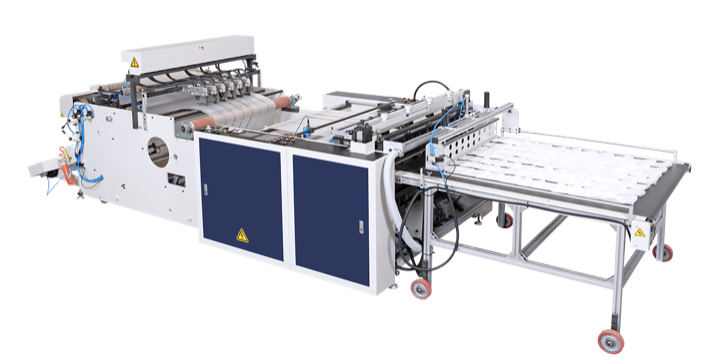
COSMO SE-40S / SE-50S fully automatic bottom seal bag making machine with hot-slitting system
Watch: SE-40S Demo Video
See also: Bottom Sealing Bag Machine: A Practical Buyer’s Guide
Side Seal
A side-seal machine seals and cuts along the vertical edges of the bag, while the bottom is usually a fold rather than a seal. That leaves the top edge free for handle punching, wicket holes or a curved wave-top profile.
- Used for: wicket bags, wave-top carry-out bags, cup carriers, and loop-handle, die-cut-handle, draw-tape and patch-handle bags
- Loop (soft-loop) handle: a separate loop of film is sealed to the bag mouth, giving a soft carrying grip
- Die-cut handle: the handle hole is punched straight through the top of the bag
- Draw tape: a drawstring tape runs through a hem at the top, so the bag can be pulled closed
- Patch handle: a reinforcing patch is sealed around the die-cut hole to strengthen it
- Our range: the SH-800-F4 / SH-1000-F4 produce all four handle styles above. The published SH-800-F4 specifications list a 70–75 mm top gusset and a maximum 85 mm bottom gusset.
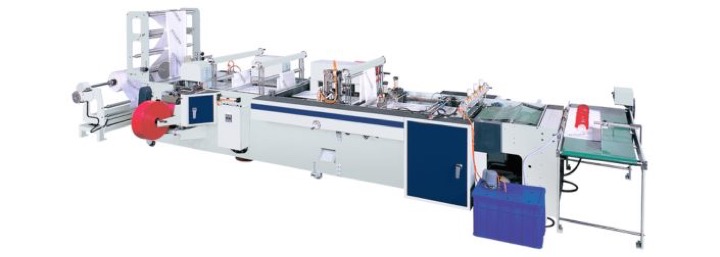
COSMO SH-800-F4 / SH-1000-F4 side seal bag making machine for loop handle, die-cut handle, draw tape and patch handle bags
Watch: SH-1000-F4 Demo Video
See also: Side Sealing Bag Making Machine Selection Guide
See also: Choosing a Drawstring Bag Making Machine? Compare Draw Tape, Patch, Loop and Die-Cut Bags
Star Seal
A star seal is made by folding the bottom of the film several times and sealing across the folds. When the bag opens, the bottom spreads into a star shape instead of a flat seam.
- Used for: round bin liners and wet waste, since the bottom conforms to round containers and reduces the corner gaps where flat-seal liners tend to leak
- Limitation: the seal passes through several layers, so very heavy-gauge liners are usually made with a flat seal instead
- Our range: the coreless SR-40 / SR-50 (0.008–0.060 mm per layer) and the SOSR-1000-R, which combines bottom seal and star seal on one coreless line
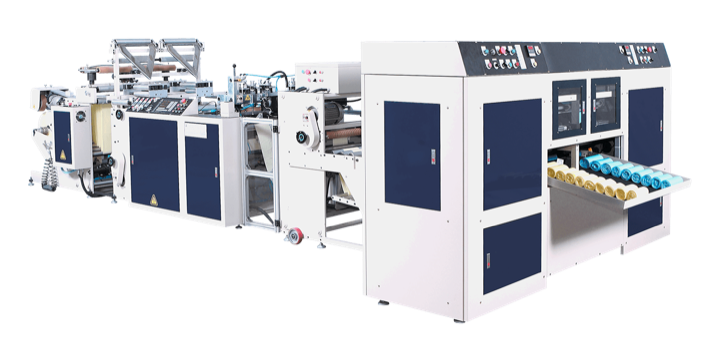
COSMO SR-40 / SR-50 2-line coreless star seal bag-on-roll making machine
Watch: SR-40 Demo Video
Types of Plastic Bags by Shape and Use
Beyond the seal, plastic bags also differ in shape and use: the top profile (handles, wicket holes or a wave top), whether the bag is gusseted, and whether it is supplied flat, folded or on a roll. Gusseted plastic bags have folds in the sides or bottom that let them expand when filled; side gussets are common on T-shirt bags, and bottom gussets on carry-out bags.
T-shirt Bags
T-shirt (vest) bags are the handle-punched carriers used at supermarket and retail checkouts. They are made from side-gusseted film: the machine seals and cuts the film into bags and punches out the handles in one pass, from film roll to finished bag.
- ST-88: 2 lines, 180–250 pcs/min per line; bag length 350–650 mm, width 160–365 mm; film 0.008–0.05 mm
- ST-77 (bio-film and PLA film): bag length 350–650 mm, width 160–360 mm; 180–250 pcs/min per line
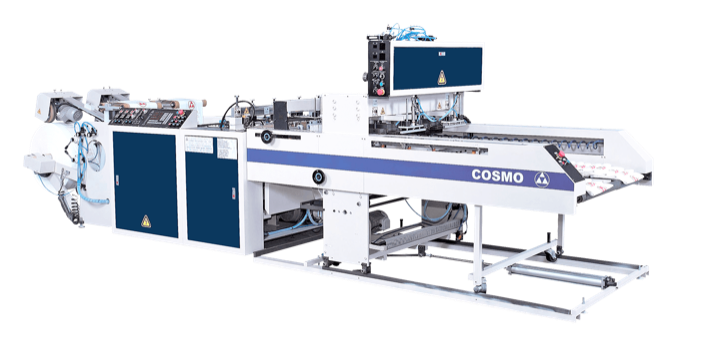
COSMO ST-88 2-line high speed T-shirt bag making machine
Watch: ST-88 Demo Video
See also: T-shirt Bag Making Machine: The Complete Selection Guide
See also: Comprehensive Guide to Plastic Shopping Bag Making Machine
Garbage Bags (Flat, Star, S-Shape, 3- or 4-Fold)
Garbage bags (trash bags in the US) are usually packed folded or wound on a roll, and each format runs on its own machine.
- SE-40-3F / SE-50-3F / SE-40-4F / SE-50-4F (3- or 4-fold, bottom seal): bag length 650–1400 mm; width 350–810 mm (40 series) or 350–1000 mm (50 series); 30–80 pcs/min per line
- SR-40 / SR-50 (star seal, coreless roll): bag length 250–1500 mm; up to 100 meters/min per line
- SOSR-1300+2T+S+2F (S-shape, 4-fold, bottom seal): bag length up to 1300 mm, width up to 300 mm; up to 100 pcs/min
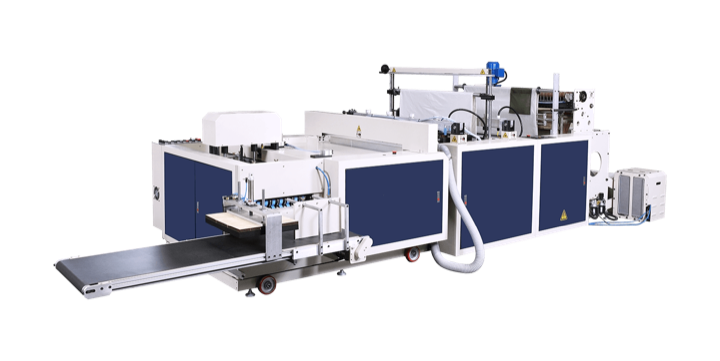
COSMO SE-40-3F / SE-50-3F / SE-40-4F / SE-50-4F 3- or 4-fold bottom seal garbage bag making machine
Watch: SE-40-3F-S2 Demo Video
See also: Everything You Need to Know About Garbage Bag Making Machines
Bags on Roll
Produce, bakery and deli bags are often supplied on a perforated roll rather than as loose flat bags. With-core rolls are wound on a core for easy dispensing, while coreless rolls skip the core to save material.
- SCR-40 (with core): bag length 150–750 mm, width 100–350 mm; film 0.008–0.035 mm; 100 meters/min per line
- SBCR-750-OB (with core; garment covers, laundry bags, garbage bags, vegetable bags and table sheets): bag length 200–1500 mm, width 300–750 mm; film 0.010–0.060 mm; 100 meters/min per line
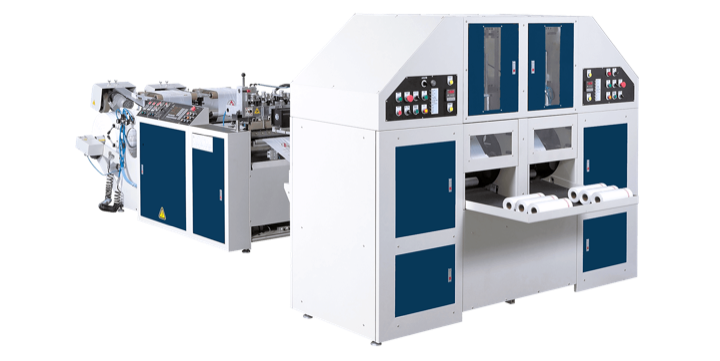
COSMO SCR-40 / SCR-50 2-line with-core vegetable bag-on-roll making machine
Watch: SCR-40 Demo Video
See also: Bags-on-Roll Machine Buyer’s Guide
Wicket & Wave Top Bags
Wicket bags hang on a wire wicket through holes punched in the lip, so they can be pulled off one at a time or fed to filling lines. Wave-top carry-out bags and cup carriers are a different bag type: they have a curved top edge instead of wicket holes and are common for takeaway food and drinks.
- SSD-600 (saddle and wicket bags): bag length 150–300 mm, width up to 550 mm; max 250 strokes/min per line
- SSD-1100-GS-L1 (wave-top carry-out, cup carrier, wet umbrella and newspaper bags): bag length 400–1000 mm, width 150–900 mm; 100–200 pcs/min; max 80 mm bottom gusset
 Wet Umbrella Bag & Plastic Newspaper Bag Making Machine - Disposable Plastic Product Making Machines.png)
COSMO SSD-1100-GS-L1 side seal machine for beverage cup carrier, wave top carry-out and wet umbrella bags
Watch: SSD-1100-GS-L1 Demo Video
See also: Wave Top Bag Making Machine: 4 Bag Types & Buying Guide
Industrial Bags
Industrial bottom-seal bags are usually larger than retail bags, so the machines take wider film rolls and cover longer bag lengths.
- SF-1500 (flying-knife cutting, jumbo or multi-roll loading): bag length 200–2500 mm, width 150–1400 mm; film 0.012–0.020 mm
- SE-1000 / SE-1200 (heavier gauge): film 0.010–0.20 mm per layer; 20–90 pcs/min per line
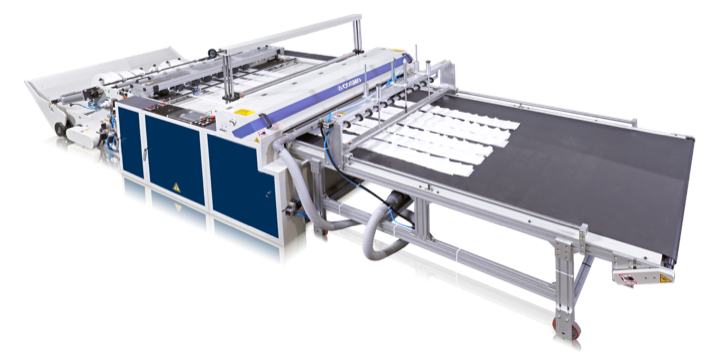
COSMO SF-1500 bottom seal industrial bag making machine with flying knife cutting system
Watch: SF-1500 Demo Video
Disposables: Gloves, Aprons, Air Column Bags
Our disposable product machines make single-use items rather than carrier bags.
- SH-800-HGL (gloves): 2-line output from jumbo film roll; melting cut-off with no cutting knife
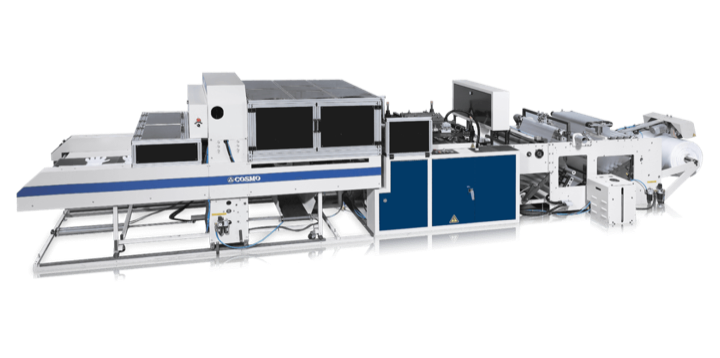
COSMO SH-800-HGL disposable plastic glove making machine
- SAP-28 (aprons): length 350–1700 mm, width 160–660 mm; 60 pcs/min
- SSCR-50-L1+BUB (air column bags for transit cushioning): width up to 450 mm; 80 meters/min per line
Watch: SSCR-50-L1+BUB Air Column Bag Making Machine Demo
See also: Disposable Glove Machine Guide
See also: Disposable Apron Making Machine Guide
See also: Air Column Bag Machine Guide
How to Match a Bag Type to a Machine
Start from the bag itself, not the machine name. Four questions narrow the shortlist:
- What seal and shape does the bag need?
- What bag size and film thickness must the line cover?
- What output do you need, and across how many lines?
- Does the bag need an add-on module such as hot slitting, side gusseting or a punching unit?
| Your requirement | What to check | Example COSMO models | Where to look |
|---|---|---|---|
| Checkout-style handle bag | Seal: bottom seal with handle punch | ST-88, ST-99, ST-77 | T-shirt Bag Making Machines |
| Round bin liner, wet waste | Seal: star | SR-40 / SR-50, SOSR-1000-R | Bags on Roll Making Machines |
| Flat liner, folded for retail | Seal: bottom, 3- or 4-fold | SE-40-3F / SE-50-3F / SE-40-4F / SE-50-4F | Bottom Sealing Bag Making Machines |
| Dispenser-rack or curved-top bag | Seal: side, wicket or wave profile | SSD-600 / SSD-1000, SSD-1100-GS-L1 | Side Sealing Bag Making Machines |
| Need both T-shirt and bottom-seal output on one line | Combo configuration | SCB-800-L4 / SCB-1100-L4, SCB-800-L8 / SCB-1100-L8 | T-shirt & Bottom Sealing Bag Making Machines |
| Disposable product, not a carrier | Glove, apron or air column format | SH-800-HGL, SAP-28, SSCR-50-L1+BUB | Disposable Plastic Product Making Machines |
Published speeds may be stated per line or for the whole machine, and in pieces, strokes or meters per minute. Where speed is given in pieces per minute per line, multiply it by the number of running lines to estimate nominal output; actual output depends on bag size, film and machine setup. Line counts and per-line speeds for some of our machines:
- SA-20 / SA-28: 1 line, 120–230 pcs/min per line
- ST-88: 2 lines, 180–250 pcs/min per line
- ST-88-G2 / G3 / G4: 2, 3 or 4 lines with hot slitting and side gusseting; published speeds reach 250 pcs/min per line
- SCB-800-L8 / SCB-1100-L8: 8 lines, 60–120 pcs/min per line
Add-on modules such as hot slitting or side gusseting vary by model. If you need both T-shirt and bottom-seal bags without running two machines, our combination T-shirt & bottom sealing machines produce both.
FAQ
What are the different types of plastic bags?
The main categories are T-shirt (vest) bags, garbage bags (flat, star, S-shape, folded), bags on roll for produce and food, wicket and wave-top carry-out bags, side-seal specialty bags (loop handle, die-cut handle, draw tape, patch handle), industrial bottom-seal bags, and air column bags for cushioning. Zipper bags and stand-up pouches are also common but require different equipment.
How are plastic bags made?
Most plastic bags go through three stages. First, resin is turned into film: PE bag film is usually blown, while CPP is cast and BOPP is biaxially oriented. Next, the film may be printed, typically by flexography. Finally, a bag making machine seals and cuts the film into finished bags, punching handles or folding them as needed. Our machines cover this last stage; film production and printing need separate equipment.
What is the difference between bottom seal and side seal bags?
A bottom-seal bag has one straight seal across the bottom. A side-seal bag is sealed along its vertical edges, leaving the top edge free for handles, wicket holes or a curved profile.
What plastic are grocery bags made of?
Most T-shirt-style grocery bags are made from HDPE film. LDPE is more common in produce and bread bags, where a softer, more flexible film is preferred.
What is a star seal garbage bag?
A star-seal garbage bag has its bottom folded several times and sealed across the folds, so it opens into a star shape. It fits round bins and helps reduce the corner leaks common with flat-seal bags.
Can one machine produce more than one type of bag?
Yes, on some models. For example, our side-seal SSD-1100-GS-L1 produces wave-top carry-out bags, cup carriers, wet umbrella bags and newspaper bags, and our combination machines produce both T-shirt and bottom-seal bags. Bottom seal and star seal can share one line on models such as the SOSR-1000-R, but side seal and star seal run on separate machines in our lineup.
How thick should plastic bag film be?
It depends on the bag type and intended load. Our published ranges run from about 0.008 mm for light T-shirt and produce bags to 0.20 mm for heavy industrial liners, and each model lists its own range.
Find the Right COSMO Machine for Your Bag Type
Established in Taiwan in 2001, we have been manufacturing plastic bag making machines for international markets and achieved ISO 9001 quality management certification in 2006. We have shipped 5,000+ machines across 90+ countries, and most of our machines use a computer-controlled servo system, so bag length and production speed can be adjusted from the control interface.
To recommend the right machine, send us:
- A finished bag sample or a dimensioned drawing.
- The film material and thickness per layer.
- Your required output in pieces or meters per minute, and whether that figure should be per line or for the whole machine.
- Whether the film will be printed, including the registration mark layout.
Get a personalized quote today to discuss your bag type and the right COSMO machine, or browse our e-catalogs to compare models by machine type.