













Bags-on-Roll Machine Buyer's Guide: Specs & 18 Models Comparison



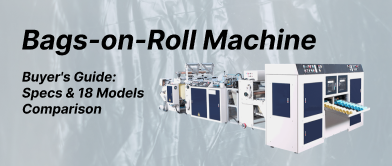
When manufacturing garbage bags on roll, manufacturers face a critical decision tree: sealing method (star seal vs. bottom seal), core configuration (with-core vs. coreless), production speed requirements, and customization needs. An ill-informed decision can lead to a cascade of operational inefficiencies, including higher production costs, slower time-to-market, and eroded profit margins.
This guide deconstructs COSMO’s 18 model portfolio, providing comparative cost-structure analyses, strategic decision frameworks, and verified performance benchmarks. Whether you are establishing your first production line or scaling existing capacity, this article maps the commercial logic behind each machine type, from entry-level single-line coreless units to high-speed dual-function systems, so you can decide on the data rather than guesswork.
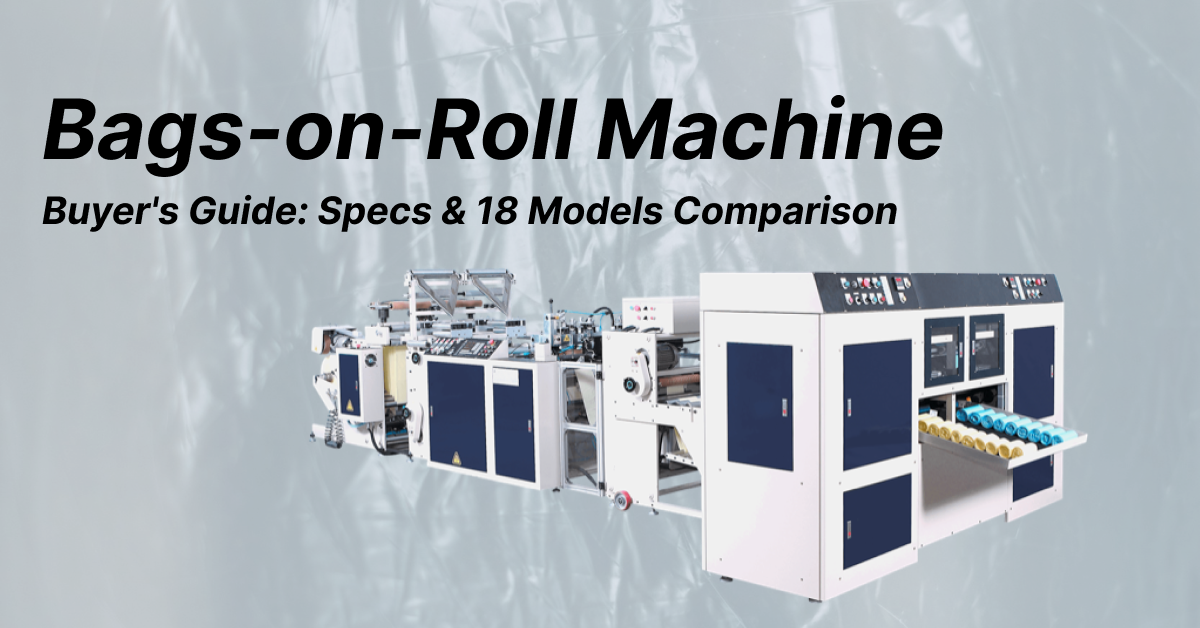
When to Choose Bags-on-Roll Machines?
Key Advantages
Bags-on-roll offer distinct operational and economic benefits across high-volume production, including:
- Production Speed: Roll-form machines deliver significantly higher throughput than flat-bottom equipment, powered by advanced continuous tension control and high-speed rotary perforation technology. For example, a typical 2-line coreless star-seal machine handles multiple lines simultaneously without film deformation.
- Material Efficiency: Roll-form minimizes film waste compared to shaped or handle-integrated flat-bottom processes, which generate trim scrap at each bag cut. Coreless configurations further enhance efficiency by eliminating core material and handling losses.
- End-User Dispensing Convenience: Bags-on-roll arrive at retail or commercial facilities pre-packaged and ready for use. Retailers can load dispensing bins faster, while commercial operators (such as restaurants and waste management firms) benefit from bulk roll efficiency in high-volume changeover scenarios.
- Retail Shelf Optimization: Roll-form bags occupy less linear shelf space than stacked flat bags, enabling retailers to display more Stock Keeping Units (SKUs) in the same footprint—a critical factor for category presence and impulse purchasing.
Ideal Customer Profiles
- High-volume retailers & chains: Organizations requiring 50,000+ units/month of private-label garbage bags. Roll-form production enables competitive retail pricing while maintaining healthy margins.
- Commercial waste operators: Firms servicing multiple properties with standardized bags; the roll-form cost structure aligns with the economics of contract supply.
- E-commerce & Direct-to-Consumer (DTC) brands: Compact roll packaging reduces shipping volume and fulfillment labor, supporting a professional presentation for online sales.
- Biodegradable/eco-friendly manufacturers: Roll-form’s material efficiency and waste-reduction narrative of coreless rolls align perfectly with sustainability-focused brand positioning.
- Regional film converters: Businesses converting parent film into finished goods to capture higher-margin revenue compared to raw film sales.
Market Applications
- Residential garbage bags: household waste liners with perforation for easy dispensing
- Heavy-duty commercial bags: industrial waste, construction debris, reinforced star-seal bags
- Biodegradable bags: compostable waste, food service
- Specialty bags: pet waste, scented liners, drawstring variants
- Institutional bulk supplies: schools, government, printed with branding
Bags-on-Roll Machine Selection Decision Matrix
Systematize your choice between Bags-on-Roll and Flat-Bottom machinery by evaluating your business across five critical dimensions:
Dimension 1 : Throughput Requirements
| Production Requirement | Recommendation | Strategic Reasoning |
|---|---|---|
| < 20,000 units/month | Flat-Bottom | Lower CapEx, simpler operations, risk-appropriate for emerging volume |
| 20,000–75,000 units/month | Flat-Bottom or Entry-Level Roll-Form | Inflection point; consider transition path to roll-form as volume scales |
| 75,000–200,000 units/month | Roll-Form (standard 2-line) | Per-unit cost advantage favors roll-form; flat-bottom becomes cost disadvantage |
| > 200,000 units/month | Roll-Form (Multi-Line) | High-speed, multi-line roll-form mandatory for margin targets |
Dimension 2 : Brand Positioning & Market Segment
| Market Segment | Recommendation | Reasoning |
|---|---|---|
| Commodity (High Volume) | Roll-Form | High-speed multi-line formers drastically reduce per-unit labor costs, crucial for price competition. |
| Commodity (Startup) | Flat-Bottom | Ideal for new entrants needing to compete on price without heavy upfront investment, resulting in a faster payback. |
| Mid-Market Retail | Roll-Form | Competitive retail pricing without eroding margin. |
| Premium/Branded | Flat-Bottom | Lower volumes and higher ASP justify slower production; individual packaging supports premium positioning. |
| Eco-Friendly | Roll-Form | Sustainability narrative (coreless) aligns with brand values while offsetting material costs. |
| Commercial/Industrial | Roll-Form | High-volume contracts demand the roll-form cost structure; efficiency is critical for margin. |
Dimension 3: Transportation & Logistics Economics
| Shipping Profile | Recommendation | Reasoning |
|---|---|---|
| Local/Regional (< 500 km) | Roll-Form | Shipping impact is minor; focus on operational efficiency at retail/commercial sites. |
| National (500–2,000 km) | Roll-Form or Flat-Bottom | An inflection point where logistics costs begin to challenge production speed advantages. |
| Export/Long-Distance (> 2,000 km) | Flat-Bottom | Flat bags generally stack flatter and denser than rolls, which can improve container payload and lower freight cost per unit on long hauls. |
| E-Commerce/DTC | Roll-Form | Compact rolls reduce fulfillment volume, sorting labor, and individual carton costs. |
Dimension 4: End-User Machinery Compatibility
| End-User Context | Recommendation | Reasoning |
|---|---|---|
| Retail (self-checkout) | Roll-Form | Rolls integrate with retail bin dispensers; reduces restocking labor |
| Commercial Operator | Roll-Form | Bulk roll supply reduces restocking labor and facilitates large-scale procurement. |
| Direct Consumer | Flat-Bottom | Consumers in certain markets are accustomed to individually-sealed formats. |
| Institutional Procurement | Flat-Bottom | Contracts often specify individually-sealed packaging; flat-bottom is mandatory. |
| Industrial/Construction | Roll-Form | High-volume usage; operators prefer bulk rolls for convenience and cost advantages. |
Dimension 5: Strategic Flexibility & SKU Management
| Business Model | Recommendation | Reasoning |
|---|---|---|
| Single-SKU Production | Flat-Bottom | A dedicated flat-bottom line is appropriate for high-volume, single-product runs. |
| Multiple SKUs (3–10) | Roll-Form with Dual-Function | Speed compensates for changeover time; dual-function enables rapid SKU switching. |
| High-Mix Portfolio (15+) | Roll-Form Flexible Core/Coreless | Switching configurations without equipment changes supports high product variety. |
| Product Testing | Flat-Bottom | Lower CapEx and simpler mechanics reduce risk during experimental phases. |
| Mature, Scaling Product Line | Roll-Form | Once product-market fit is validated, roll-form investment is justified for efficiency. |
Sealing Methods : Engineering Principles & Bag Morphology
Star Seal (Star-Bottom)
Sealing Mechanism
The star-seal configuration is achieved through a precise geometric folding and sealing process. The blown film tube is continuously-folded via multiple V-folding boards into a multi-layer narrow gusseted strip. A standard linear sealing bar then applies heat and pressure transversely across this layered web. When opened, the seal expands into a radiating star shape. This multi-layered center point effectively distributes multi-directional stress away from a single linear vector.
Structural Features & Benefits
- Omnidirectional Weight Distribution: Eliminates vulnerable corner stress points by spreading the load evenly across the bottom substrate, resulting in a superior load capacity for heavy waste.
- Optimal Bin Volumetric Fit: Naturally conforms to the geometry of cylindrical containers, eliminating “dead corners” and maximizing real-world volume utilization for janitorial and round-can liners.
- Enhanced Leak Resistance: Condenses potential failure points into a single, reinforced multi-layered center point rather than a long horizontal seam, minimizing bag rupture risks.
- In-Line Perforation Efficiency: The highly compressed multi-layer web configuration allows clean, high-speed rotary perforation, so rolls integrate cleanly on the production floor.
Operational Considerations
- Tension Control: Demands precise continuous tension synchronization to prevent film shifting during the multi-folding process.
- Thermal Penetration Limits: Heat penetration becomes challenging for exceptionally thick film gauges (≥ 0.050mm) because the thermal energy must pass through the multi-layer stack.
Ideal Applications
- High-turnover consumer retail garbage rolls (with coreless perforation)
- Commercial facility/janitorial round-can liners
- High-speed S-shape wave-top bag production lines
Bottom Seal
Sealing Mechanism
Bottom-seal machines create a straight horizontal heat-seal line across the bag bottom. A transverse heat-sealing bar presses perpendicular to the film web, creating a continuous linear seal. Heat intensity and dwell time are the primary control variables.
Structural Features & Benefits
- Clean Aesthetics & Dimensional Control: Creates a centered, uniform seal line where the film width translates directly to bag width with zero geometric variation, supporting a premium, traditional appearance.
- Precise Thermal Control for Eco-Polymers: The single-ply or double-ply linear layout allows stable heat penetration, delivering a high ROI for compostable or biodegradable materials that utilize narrow-tolerance polymers.
- Universal Folding Compatibility: Accommodates sequential V, C, N, and M folding systems post-sealing without geometric or structural complications.
- Mechanical Simplicity: Utilizes a straightforward linear sealing toolpath, drastically lowering initial tool maintenance costs and boosting operational uptime.
Operational Considerations
- The “Dog-Ear” Phenomenon: When deployed in cylindrical bins, the flat geometry creates pronounced corner flaps (“dog-ears”) where liquid waste can pool, leading to less uniform weight distribution compared to a star seal.
- Puncture Vulnerability: Standard horizontal seams concentrate stress along a single linear vector, making them less ideal for sharp or heavy industrial debris.
Ideal Applications
- Commodity Retail Liners: High-volume, cost-per-unit driven garbage bags for price-sensitive consumer markets.
- Secondary-Folded Products: Table sheets, institutional liners, and retail bags requiring specific V/C/N/M compact folding patterns.
- Lightweight Facility Waste Management: Janitorial and office liners where high-puncture resistance against heavy/wet waste is not required.
- Eco-Friendly Specialty Formats: Compostable or biodegradable bags that need stable, single-ply heat sealing.
Special Secondary Folding Configurations
In advanced machinery platforms (such as the SMNR and SMNRCR series), folding occurs via sequential folding boards and mechanical guides to compact wide bags into narrow rolls:
- V-Fold (Single/Center Fold) : Symmetrical longitudinal fold; halves the width before winding.
- C-Fold (Concentric/Accordion Fold) : Edges fold inward toward the center; creates a highly compact roll width.
- Z-Fold / N-Fold (Zig-Zag Fold) : Alternating directions; allows exceptionally wide industrial liners to fit small-profile rolls.
- M-Fold (Gusseted Fold) : Integrated pre-sealing to create side-gussets; favored for rectangular bins.
Inter-Leaved Production Technology
Inter-leaved refers to a perforation-free packaging method where individual bags are automatically folded and overlappingly inserted during winding.
Mechanical Mechanism & Machines
Utilizing platforms like the SIR-400-L2 (90 m/min) or SSIR-300-L2 (100 m/min), bags are cut individually and fed via a high-speed rotary overlapping finger system. This ensures that pulling one bag seamlessly draws up the next.
Value-Driven Applications
- Premium Janitorial & Institutional Supply : Heavily utilized by contract manufacturers supplying luxury hotels, medical facilities, and corporate offices where the friction and noise of tearing perforated bags are undesirable.
- Zero-Damage Dispensing : Prevents the tearing or structural failure at the bag rim that frequently occurs with poorly perforated roll-bags during high-velocity commercial changeovers.
- Operational Efficiency : Cuts facility labor by dispensing one bag at a time and preventing several from pulling out at once.
Core Configuration : With-Core vs. Coreless vs. Hybrid
Coreless Machines
Engineering Principles
Coreless machines utilize an expanding air mandrel or friction-based winding system that eliminates the need for a cardboard or plastic core. The film is wound directly onto itself, forming a self-supporting roll. This design reduces material consumption and simplifies the winding process.
Advantages:
- Material Cost Savings: Geometrically eliminates ongoing expenditures for purchasing, shipping, and warehousing cardboard or plastic cores.
- Environmental Sustainability: Eliminates downstream core disposal and carbon footprint, aligning perfectly with green branding and zero-waste initiatives.
- Volumetric Efficiency: Removing the dead space of a physical core allows a higher bag count per roll within identical outer diameter (O.D.) limits, reducing changeover frequency for end-users.
- Logistics Optimization: Reduces overall gross roll weight and individual package volume, lowering transoceanic or direct-to-consumer (DTC) shipping costs.
- Modern Hardware Fit: Provides flawless compatibility with contemporary retail and high-turnover commercial automated dispensing bins.
Disadvantages:
- Higher Initial CapEx: Requires a more sophisticated machinery design, incorporating high-tier PLCs, advanced taper tension control software, and precision air-expanding mandrels.
- Roll Stability Sensitivity: Without an internal rigid substrate, rolls can suffer from telescoping or collapsing if the winding web tension is not properly modulated during high-speed extraction.
With-Core Machines
Engineering Principles
With-core machines wind the film onto a pre-inserted cardboard or plastic core. The core provides structural integrity to the roll, making it easier to handle and dispense in certain applications. Cores are typically fed automatically into the winding station.
Advantages:
- Lower Initial CapEx: Employs a simplified winding mechanism that avoids high-cost multi-axis servo synchronization, resulting in significantly lower upfront machinery investment.
- Structural Rigidity & Handling: The physical core acts as a rigid backbone, preventing roll deformation and ensuring seamless compatibility with legacy or gravity-fed dispensing hardware.
- Market Infrastructure Alignment: Matches long-standing consumer habits and established retail/commercial dispensing frameworks in developing regional markets.
- Extended Film Gauge Tolerance: Provides continuous internal support that prevents structural collapsing (coring) in ultra-thin films and effectively resists the high elastic memory of exceptionally thick gauges.
Disadvantages:
- Continuous Material Expenditure: Imposes ongoing operational costs (OpEx) for purchasing, transporting, and warehousing cardboard or plastic core inventory.
- Downstream Waste Generation: Produces post-consumer core waste that complicates disposal streams and challenges modern corporate sustainability profiles.
- Logistics Freight Penalty: Adds dead weight and physical volume (geometric dead space) to each roll, inflating transoceanic container or long-distance shipping costs per unit.
Core & Coreless (Hybrid) Machines
Engineering Principles
Hybrid machines offer the flexibility to switch between with-core and coreless production modes. This is typically achieved through interchangeable mandrels or a universal winding system that can adapt to both configurations. The ability to switch modes allows manufacturers to cater to diverse customer requirements with a single machine.
Advantages:
- Maximum Market Flexibility: Empowers manufacturers to seamlessly serve both core-preferring legacy markets and eco-conscious coreless segments using a single production line.
- Capital Future-Proofing: Allows operations to instantly adapt to evolving regional legislation and shifting brand sustainability mandates without purchasing secondary machinery.
- Product Portfolio Diversification: Expands the factory’s SKU capabilities across a broad range of applications (from retail consumer rolls to institutional bulk liners) on one floor footprint.
Disadvantages:
- Elevated Upfront CapEx: Demands a premium initial investment due to hardware redundancy (dual integration of air-expanding mandrels and automated core-feeding hoppers) and high-tier multi-axis PLC systems.
- Operational Changeover Downtime: Transitioning between cored and coreless modes requires mechanical re-configuration and sensor re-alignment, creating temporary production windows of zero throughput.
Ideal Applications by Configuration
| Configuration | Ideal Applications |
|---|---|
| Coreless |
|
| With-Core |
|
| Hybrid (Core & Coreless) |
|
Once your commercial targets point toward a roll-form setup, the next step is selecting the right sealing architecture. To help you evaluate your options, the following Master Specification Table maps all 18 COSMO machines for quick cross-reference.
Bags-on-Roll Machine Specification Table
The following table consolidates all COSMO Bags-on-Roll machines using verified specifications from COSMO’s product pages. Use this as a quick-reference to identify machines matching your requirements.
| Model | Sealing Type | Core Config | Lines | Bag Length (mm) | Bag Width (mm) | Film Thickness (mm) | Speed (m/min) | Power (kVA) | Machine Dimension (mm) |
|---|---|---|---|---|---|---|---|---|---|
| SMNR-1000 | Bottom | Coreless | 1 | 200–1500 | 300–900 | 0.008–0.060 | 60–100 | 12 | 7450 × 1820 × 1860 |
| SMNRCR-1000 | Bottom | Core & Coreless | 1 | 200–1500 | 300–900 | 0.008–0.060 | 60–100 | 15 | 8750 × 3000 × 2000 |
| SR-40 | Star | Coreless | 2 | 250–1500 | 100–330 | 0.008–0.060 | Up to 100 | 20 | 6750 × 2750 × 1950 |
| SR-50 | Star | Coreless | 2 | 250–1500 | 100–430 | 0.008–0.060 | Up to 100 | 20 | 6750 × 3200 × 1950 |
| SRCR-40 | Star + Bottom | Core & Coreless | 2 | 250–1500 (coreless) / 150–750 (core) | 100–330 (coreless) / 150–350 (core) | 0.008–0.035 | Up to 100 | 20 | 5800 × 2750 × 1950 |
| SRCR-50 | Star + Bottom | Core & Coreless | 2 | 250–1500 (coreless) / 150–750 (core) | 100–330 (coreless) / 150–400 (core) | 0.008–0.035 | Up to 100 | 20 | 5800 × 3200 × 1950 |
| SRCR(CF)-40 | Star + Bottom | Core & Coreless | 2 | 250–1500 | 100–330 (coreless) / 150–350 (core) | 0.008–0.060 | Up to 100 | 20 | 7750 × 2750 × 1950 |
| SRCR(CF)-50 | Star + Bottom | Core & Coreless | 2 | 250–1500 | 100–430 (coreless) / 150–450 (core) | 0.008–0.060 | Up to 100 | 20 | 7750 × 3200 × 1950 |
| SOSR-1000-R | Star + Bottom (Hybrid) | Coreless | 1 | 500–3000 | 300–900 | 0.008–0.060 | 60–150 | 30 | 7733 × 1820 × 1600 |
| SR-40-R4S+OS | Star + Bottom | Coreless | 2 | 250–1500 | 100–330 | 0.006–0.035 | Up to 150 | 20 | 7300 × 2750 × 1950 |
| SR(2)MR(1)-1000-OS-2T-R3S | Star + Bottom | Coreless | 1↔2 | 350–1500 | — | 0.008–0.060 (bottom) / 0.008–0.035 (star) | Up to 150 | 30 | 10000 × 2600 × 2500 |
| SIR-400-L2 | Star + Bottom (Inter-Leaved) | Coreless | 2 | 250–1500 | 100–300 | 0.008–0.035 | Up to 90 | 20 | 7000 × 2740 × 1950 |
| SSIR-300-L2 | Star + Bottom (Inter-Leaved) | Coreless | 2 | 250–800 | 160–250 | 0.008–0.035 | Up to 100 | 12 | 5000 × 1460 × 1280 |
| SBCR-750-OB | Star | With Core | 1 | 200–1500 | 300–750 | 0.010–0.060 | Up to 100 | 12 | 7450 × 1680 × 1920 |
All specifications sourced from manufacturer product pages and subject to change without notice.
COSMO Bags-on-Roll Machine Line Up
Entry-Level Segment
SMNR-1000 — Single-Line Coreless V/C/N/M Fold Garbage Bag & Table Sheet Machine
- Core Strengths: V/C/N/M fold capability enables product diversification (garbage bags, table sheets, food-service covers). Handles bag widths up to 900mm and a film range of 0.008–0.060mm—the broadest in the entry-level segment. Coreless operation eliminates core material costs. Compact single-line footprint.
- Best Fit: Startups, specialty food-service/hospitality producers, developing markets where V/C/N/M fold matches local expectations.
- Limitations: Single-line caps throughput; scaling requires a second machine or upgrade to 2-line models.
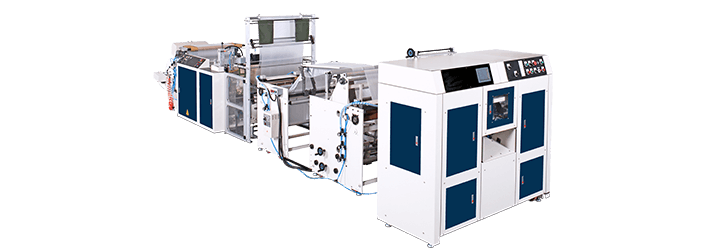
SMNRCR-1000 — Single-Line With-Core & Coreless V/C/N/M Fold Machine
- Core Strengths: Inherits all SMNR-1000 capabilities plus easy switchable core-to-coreless function. Enables serving both retail (with-core) and commercial (coreless) customers from one line.
- Best Fit: Manufacturers serving mixed customer bases or testing market response to core vs. coreless format.
- vs. SMNR-1000: Capex premium for dual-function mandrel. Justified if a meaningful share of production requires the alternative configuration. Note larger footprint (8750mm vs. 7450mm).
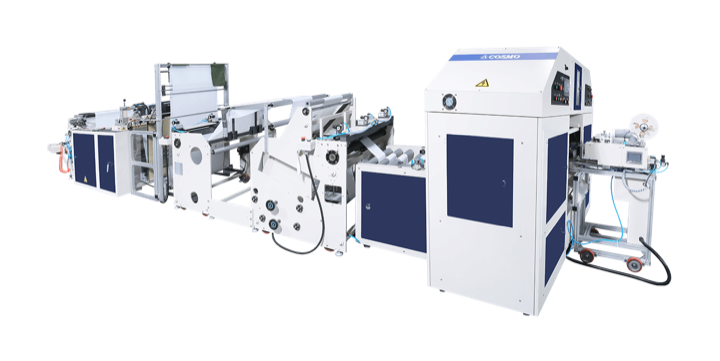
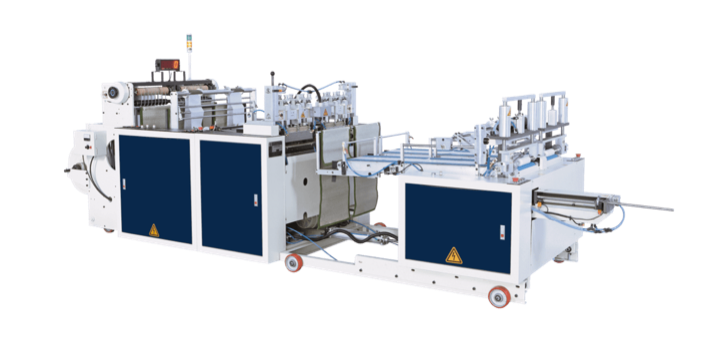
SSIR-300-L2 — Semi-Automatic 2-Line Coreless Inter-Leaved Star Seal & Bottom Seal Machine
- Core Strengths: Most compact and lightest model in the portfolio. Hybrid sealing (star + bottom alternating on the same roll) from one machine.
- Best Fit: Contract manufacturers with mixed-specification orders, facilities with limited floor space or power, manufacturers evaluating hybrid demand before upgrading to SIR-400-L2.
- Limitations: Narrow bag width (max 250mm), short bag length (max 800mm), thin film only (max 0.035mm), semi-automatic operation.
Mid-Market Segment
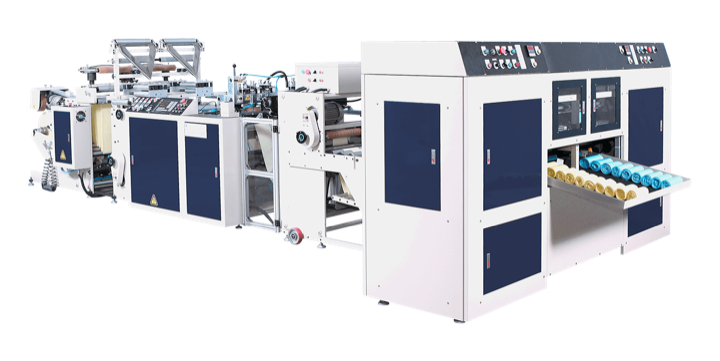
SR-40 / SR-50 — 2-Line Coreless Star Seal Bag on Roll Machine
- Core Strengths: Proven platform across 90+ countries. A/B lines produce different bag lengths independently. Wide film range (up to 0.060mm) handles both thin commodity and thicker heavy-duty applications.
- Best Fit: Mid-volume coreless star-seal garbage bag producers, private-label supermarket suppliers.
- Upgrade Path: SR-40-R4S+OS for 150 m/min speed and tighter roll consistency.
- SR-40 vs. SR-50: Identical architecture; difference is max bag width (330mm vs. 430mm). If all products fit within 330mm, SR-40 saves floor space (2750mm vs. 3200mm width).
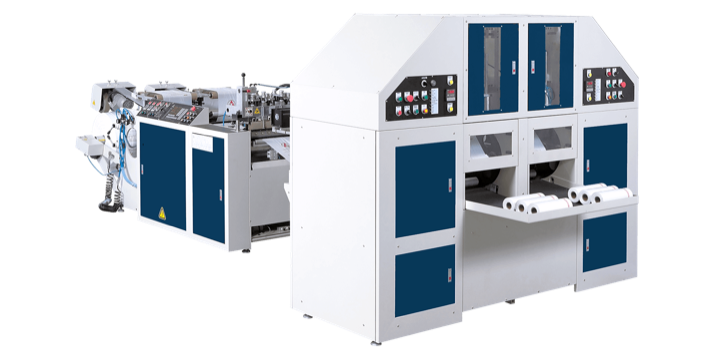
SCR-40 — 2-Line With-Core Vegetable Bag on Roll Machine
- Core Strengths: Automatic core-changing system. Most compact mid-market 2-line footprint (6280mm length). Lower power (18kVA).
- Best Fit: Produce/vegetable bag manufacturers serving supermarkets where with-core retail dispensing is standard.
- vs. SR-40/50: SCR-40 handles thinner max film (0.035mm vs. 0.060mm) and shorter bags (750mm vs. 1500mm)—optimized for produce, not heavy-duty garbage bags.
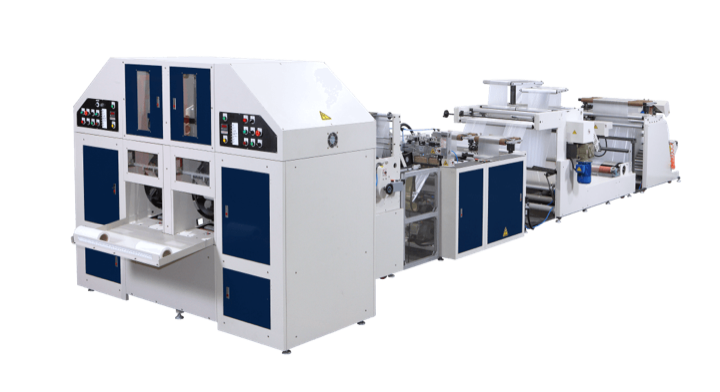
SCR-40-C2 / SCR-40-G2 — With Hot Slitting (C2) / Hot Slitting + Gusseting (G2)
- Core Strengths: Both models share identical specifications to SCR-40, but with integrated additional functions. SCR-40-C2 adds hot slitting, enabling in-line cutting of wider film into narrower finished bags, eliminating secondary slitting operation. SCR-40-G2 adds side gusseting on top of hot slitting, creating expandable side folds for bulky contents.
- Best Fit: Choose C2 if you need slitting only. Choose G2 only if gusseting is required. Both trade compact footprint for integrated functionality.
SRCR-40 / SRCR-50 — 2-Line Core & Coreless Bag on Roll Machine
- Core Strengths: Mid-market dual-function (core & coreless). Note the specification shift between modes: coreless handles longer bags (up to 1500mm), core mode handles shorter bags (up to 750mm).
- Best Fit: Converters serving both retail and commercial segments, manufacturers transitioning between core and coreless.
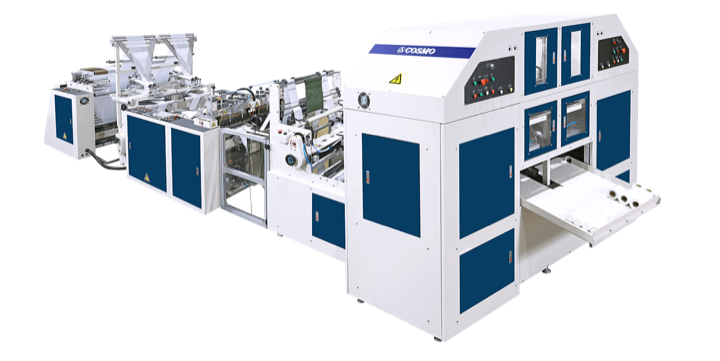
SRCR(CF)-40 / SRCR(CF)-50 — Sufra, Table Cover, Table Sheet Machine (Core & Coreless)
- Core Strengths: Compared to SRCR-40/50, adds C-fold device and mid-cutting open device. Handles thicker films (up to 0.060mm vs. 0.035mm).
- Best Fit: Markets where sufra/table cover rolls are a staple product, food-service suppliers, manufacturers combining garbage bag and table-cover production.
Premium Segment
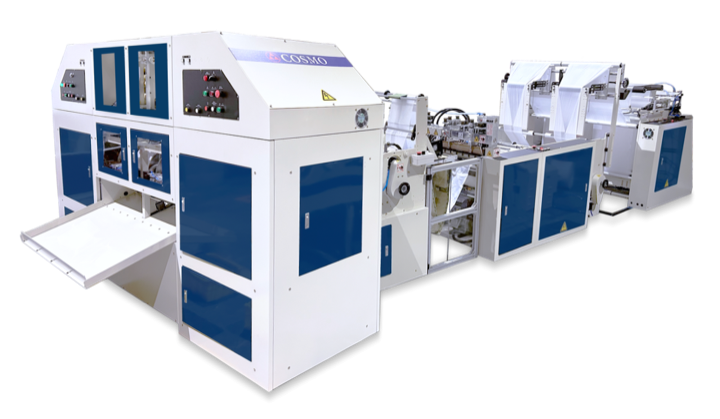
SOSR-1000-R — Coreless Bottom Seal & Star Seal Hybrid Machine
- Core Strengths: Broadest bag dimensions in portfolio (up to 3000mm × 900mm). Largest finished roll capacity (Ø900mm).
- Best Fit: Contract manufacturers with diverse sealing specs, oversized industrial bag production, high-volume producers needing sealing flexibility.
- Sealing Flexibility: One platform spans the full sealing-format range—star, bottom, perforation, and S-shape—serving diverse product specs from a single machine without changeover to a separate line.
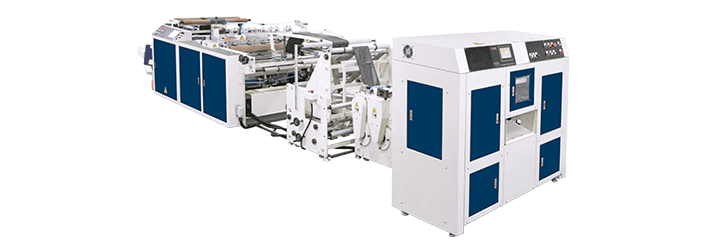
SR(2)MR(1)-1000-OS-2T-R3S — Dual-Function Single/Dual-Line Machine
- Core Strengths: Only model offering single-line ↔ dual-line switching. Shuttle system & 3-shaft re-wind. Largest parent roll capacity (Ø1000mm). Both star and bottom sealing.
- Best Fit: Multi-SKU operations with variable volume demand.
- Note: Largest footprint in portfolio (10000 × 2600 × 2500mm).
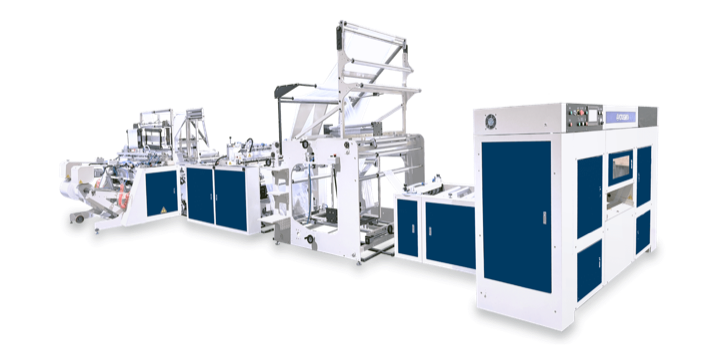
SR-40-R4S+OS — 4-Shaft Rewinder System
- Core Strengths: Fastest standard model (tied with SR(2)MR(1)-1000). Thinnest film support in portfolio (down to 0.006mm). 4-shaft rewinder for tightest roll consistency.
- Best Fit: High-volume retail chain suppliers, export manufacturers with automatic packaging systems.
- vs. SR-40: Same bag dimensions. SR-40-R4S gains 50% more speed (150 vs. 100 m/min), thinner film capability (0.006mm vs. 0.008mm), and superior roll consistency. Trade-off: larger footprint and higher investment.
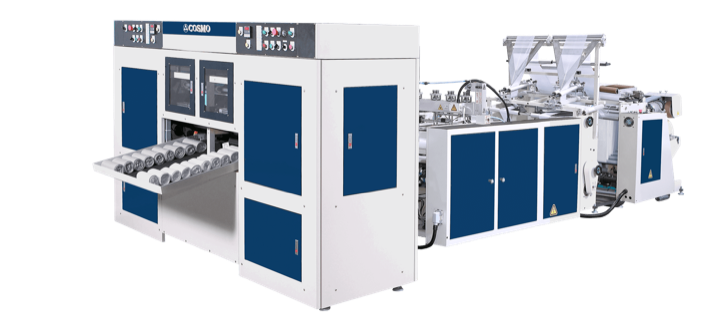
STR-40-L2-OS-R3S — High-Speed 2-Line Coreless 3-Shaft Rewind T-Shirt/Garbage Bag on Roll Machine
- Core Strengths: Three-shaft rewinder for continuous high-output operation. Shuttle film feeding & sealing system stabilizes output at speed. Widest bag length in the mid-market segment (up to 1600mm, vs. 1500mm for SR-40/50). Higher power draw (35kVA) supports sustained 120 m/min/line throughput.
- Best Fit: High-volume T-shirt and garbage bag converters needing continuous rewind capacity without manual roll-change downtime; export manufacturers prioritizing uptime over footprint.
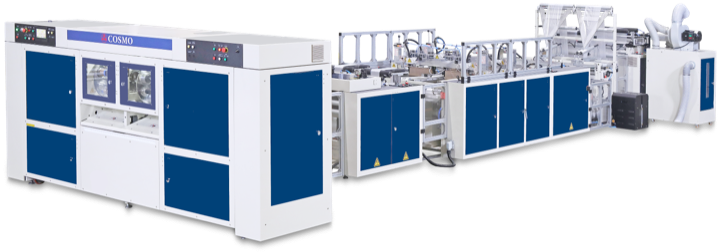
SIR-400-L2 — Fully Automatic 2-Line Coreless Inter-Leaved Star Seal & Bottom Seal Machine
- Core Strengths: Fully automatic inter-leaved hybrid sealing. Compared to the semi-automatic variant, it handles wider (300mm vs. SSIR’s 250mm) and longer (1500mm vs. 800mm) bags, with larger capacity.
- Best Fit: Contract manufacturers with validated hybrid-sealing demand, brands marketing dual-format rolls.
- vs. SSIR-300-L2: Upgrade gains—full automation, wider/longer bags, larger capacity. Trade-off: slightly lower max speed (90 vs. 100 m/min), larger footprint (7000mm vs. 5000mm).
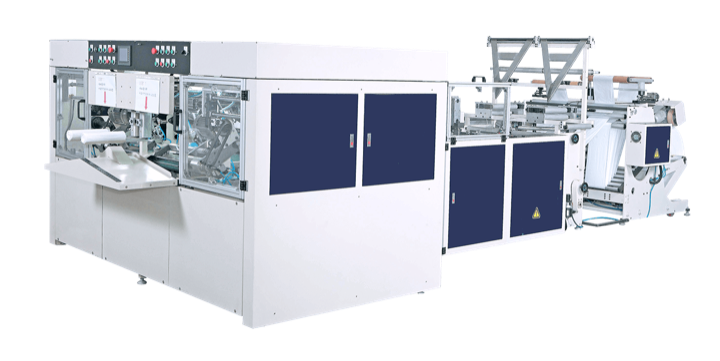
SBCR-750-OB — Single-Line With-Core Garment Cover, Garbage Bag, Vegetable Bag & Table Sheet Machine
- Core Strengths: Only model designed for garment cover (laundry bag) production. Widest finished roll (Ø180 × 750mm) among with-core models. Low power (12kVA).
- Best Fit: Laundry/dry-cleaning suppliers, hospitality garment cover producers, multi-product converters serving hospitality + food-service + waste management.
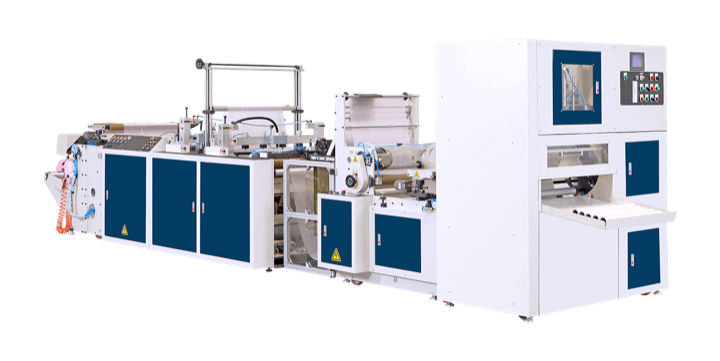
Bags-on-Roll Machine Pre-Purchase Checklist
Before finalizing your bags-on-roll machine investment, validate these three critical questions:
-
Actual Speed Requirements
Calculate based on monthly order volume. Mid-market models (100 m/min) are often sufficient, avoiding over-investment.
-
Film Thickness Range
Ensure your target gauge matches the machine’s verified limit (either 0.035mm or 0.060mm).
-
Customer Core Preferences
Survey clients to determine if cardboard cores are mandatory or if coreless rolls are acceptable.
Why Choose COSMO?
- 35+ years of bag-making machine expertise, 5,000+ machines delivered to 90+ countries.
- All 18 roll-form models share a common servo-driven, PLC-controlled platform, so switching between star seal, bottom seal, core, coreless, and hybrid configurations doesn’t mean relearning a new system.
- ISO 9001 and CE certified; every machine sourced from established component brands for consistent build quality.
- Our range runs from entry-level single-line coreless units to high-speed multi-line and dual-function systems. Whether you’re testing a new product line or scaling past 200,000 units/month, there’s a fit.
- Direct technical consultation matches your bag dimensions, film specs, and production volume to the optimal configuration, rather than a one-size-fits-all sale.
Transform Your Bags-on-Roll Machine Today
Ready to identify the right bags-on-roll machine for your production line? Contact COSMO Machinery for a technical consultation tailored to your bag dimensions, film specifications, and target volume — turn this comparison into a production line that pays for itself.