






Disposable Apron Making Machine: How It Works, Output & Buying Guide


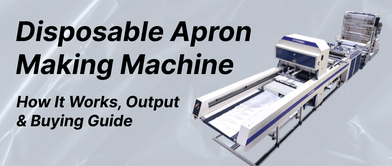
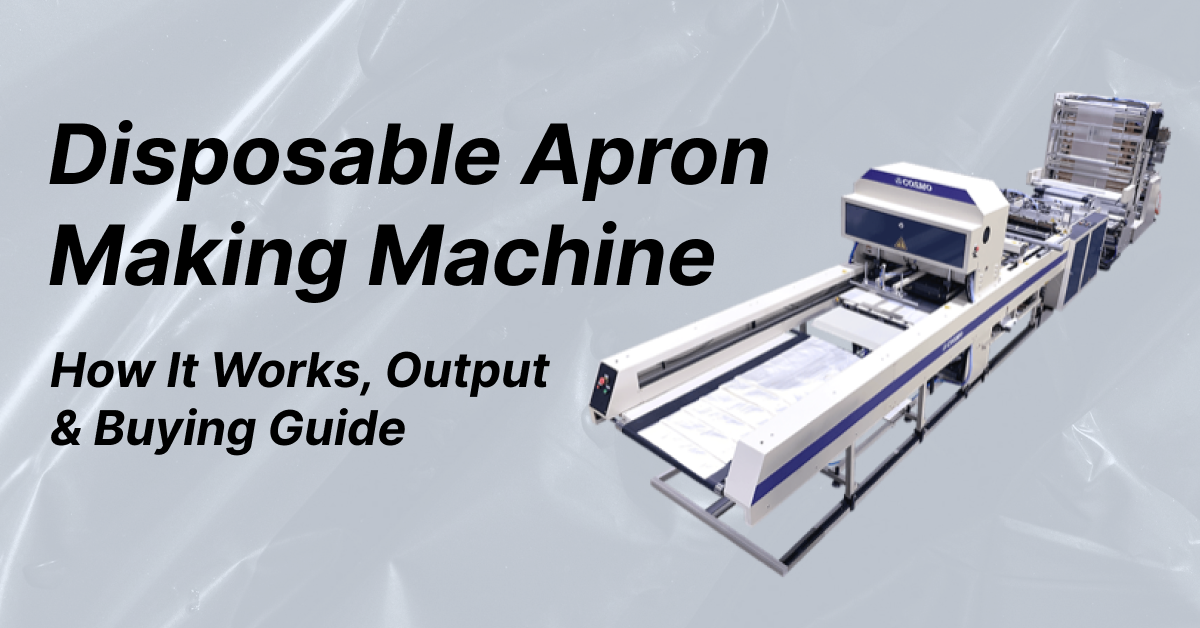
A disposable apron making machine converts plastic film rolls into single-use aprons. COSMO's SAP-28 runs at a rated production speed of 60 pieces per minute and handles a thickness range of 0.008–0.06 mm.
If you are comparing apron making machines for sale, this guide explains the production workflow, SAP-28 specifications, shift-output calculations, and the checks to make before requesting a quote. Start with your apron sample: material, dimensions, print layout, and delivery format determine whether a machine fits your requirements.
What Is a Disposable Apron Making Machine?
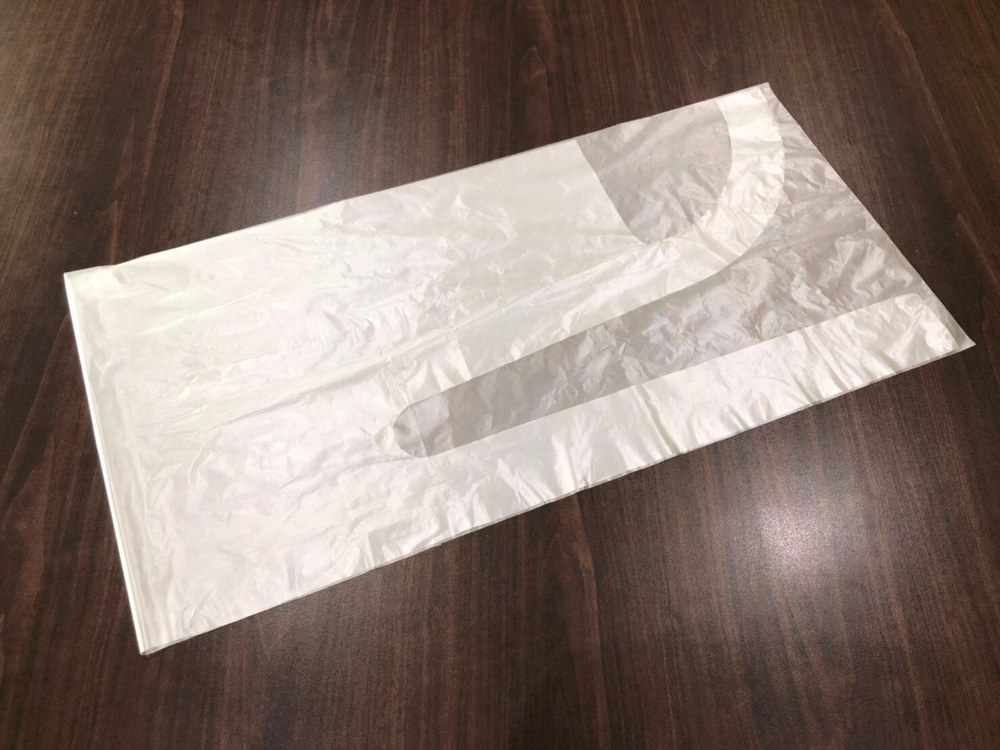
A disposable apron making machine is a film-conversion machine that feeds and shapes plastic film into disposable aprons. Because these aprons are commonly made from polyethylene (PE) film, the equipment is also called a PE apron making machine, or a polythene apron machine in British and Indian English. The finishing process varies by machine and by whether the customer needs separate aprons or aprons on a roll.
Aprons like these are used in food preparation, supermarkets, salons and barber shops, cleaning, and general hygiene tasks in care facilities. Food-contact, medical, or protective-performance requirements for the finished apron should be confirmed for your film and target market.
PE film is used for disposable plastic aprons, with high-density polyethylene (HDPE) and low-density polyethylene (LDPE) among the available material options.
How a Plastic Apron Making Machine Works
The production sequence starts with a film roll and ends with finished aprons. The SAP-28 comes with automatic film feeding, a standard servo motor, operator-interface settings for length, speed, and stack count, and automatic error detection.
Film feeding and size control
The SAP-28's automatic film feeding runs without manual tension adjustment, and apron length is set on the operator interface.
Color scanning
On printed film, sealing and cutting must stay in step with the print. The SAP-28 stops automatically when color scanning misses a mark. In bag-making machines, color-mark scanning is typically done by a photoelectric sensor, often called an electric eye, that reads printed marks on the film. Printing is a separate operation: the SAP-28 runs pre-printed or plain film.
Shaping and stacking
Finished aprons are stacked at the count set on the operator interface.
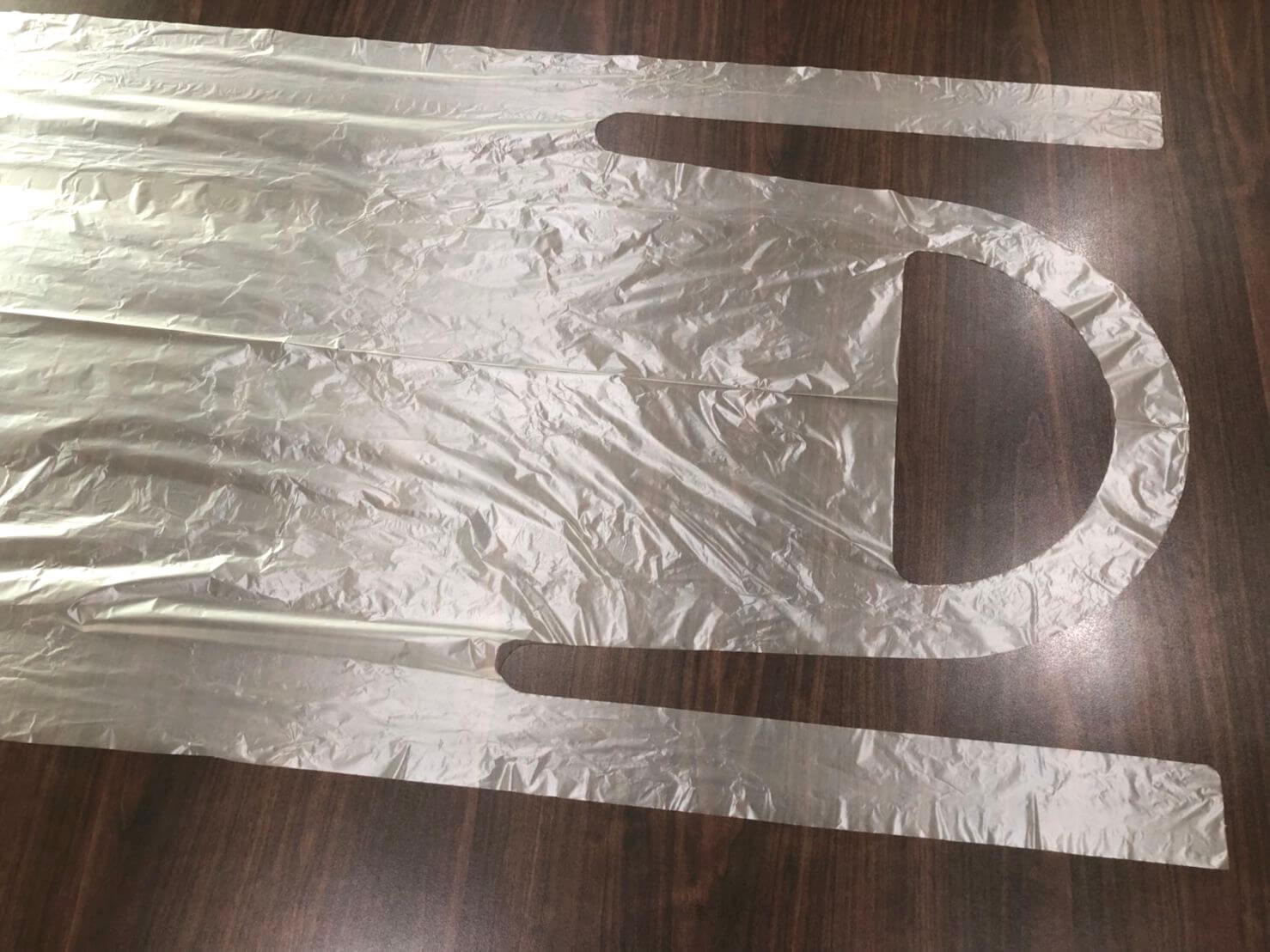
Finished disposable plastic apron with neck opening and waist ties
The SAP-28 automatically stops on film runout, feed blockage, jams, or a missed color scan. These stop functions help operators respond to faults.
Separate aprons or aprons on a roll?
Decide whether your customers need stacked aprons or perforated aprons supplied on a roll, as this affects machine selection and downstream packaging. The SAP-28 is specified for stacked output; if you need rolled aprons, tell us before placing an order.
COSMO SAP-28 Disposable Apron Making Machine
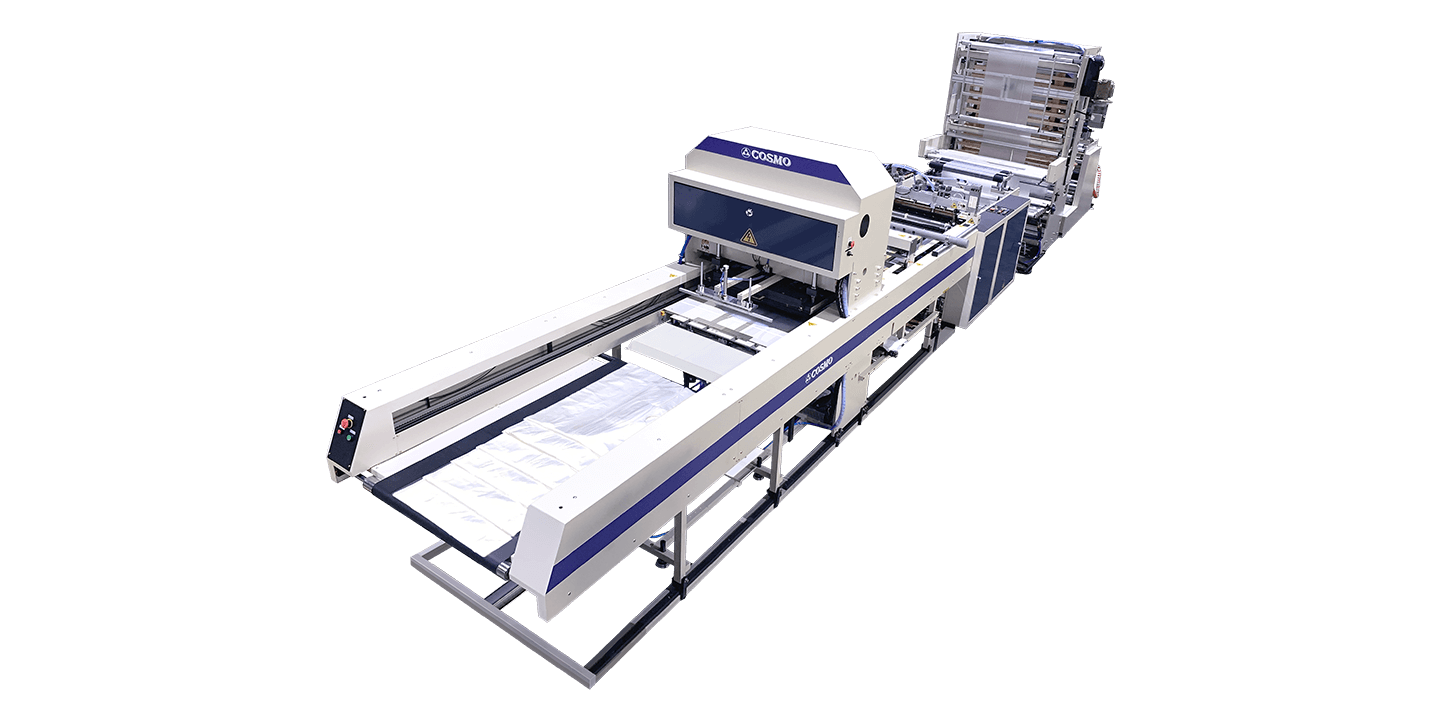
SAP-28 Specifications
| Specification | Value |
|---|---|
| Bag Size — length | 350–1700 mm |
| Bag Size — width | 160–660 mm |
| Bag Size — thickness | 0.008–0.06 mm |
| Production speed | 60 pcs/min |
| Film roll size | Ø900 × 660 mm |
| Power | 220V, 3-phase, 50/60 Hz, 10 kVA |
| Heater | 2.2 kW |
| Dimensions (L × W × H) | 8500 × 1300 × 1650 mm |
| Required air compressor | 5 HP (not included) |
Specifications are subject to change for improvement without notice. For shipping and installation planning, ask us to confirm machine weight, packing dimensions, and utility requirements in your quotation.
Disposable Apron Making Machine Output per Shift
| Period | Theoretical output at 60 pcs/min | Illustrative output at 85% efficiency |
|---|---|---|
| 1 hour | 3,600 aprons | 3,060 aprons |
| 8-hour shift | 28,800 aprons | 24,480 aprons |
| 3 shifts (24 hours) | 86,400 aprons | 73,440 aprons |
(The 85% figure is a planning assumption, not a measured SAP-28 result.)
Confirm the achievable speed for your film type, thickness, apron size, and print layout. Roll changes, setup, fault stops, and stack removal can reduce shift output. The 24-hour figure assumes three staffed shifts at the same efficiency.
For a useful capacity estimate, request a trial with your intended film and apron specification. Ask us for sustained running speed, good-piece count, and the basis used to estimate shift output.
How to Choose a Disposable Apron Making Machine
1. Match the size range to your finished sample
Compare your finished apron with the machine's size range, and supply both the unfolded dimensions and the folded or packed format. For example, the SAP-28 covers a Bag Size range of 350–1700 mm in length and 160–660 mm in width. Ask the supplier to confirm that your neck opening, ties, and outline can be produced.
2. Confirm film type and thickness
Check that your target gauge sits within the machine's thickness range. The SAP-28, for example, handles 0.008–0.06 mm (8–60 microns). Thickness alone does not confirm material compatibility, so identify the polymer, gauge, and any relevant film characteristics in your inquiry, and request a trial with representative material.
3. Define printed or plain production
For printed aprons, confirm that the machine has color-mark scanning, then supply the artwork, print repeat, and color-mark layout, and ask whether adjustments are needed between plain and printed runs.
4. Check what automation includes
Define what the machine should deliver: loose stacks, a set pack count, or another format. Confirm operator tasks for roll loading, stack removal, inspection, and packing.
5. Plan power, compressed air, and access
Check your plant's power supply and compressed air against the machine's requirements, and allow working space for loading, unloading, and maintenance.
For reference, the SAP-28 is rated at 220V three-phase, 10 kVA, needs a separate 5 HP air compressor, and has an 8.5 × 1.3 m footprint.
6. Verify the supplier and acceptance criteria
Ask any supplier for current ISO 9001 and CE documents and confirm which apply to the machine being quoted. For COSMO's manufacturing background, see our company page.
Ask about component brands, warranty coverage, spare parts, operator training, installation arrangements, and support terms, and have agreed items included in the quotation. Base acceptance on your sample, finished-product quality, demonstrated speed, and output format.
See also: Disposable Glove Making Machines That Run 300 Gloves a Minute With No Knife to Adjust
What to Send for an SAP-28 Quote
With your inquiry, include your apron sample or drawing, film type and thickness, print details, required output format, target daily output and shift pattern, and plant utilities. We will then confirm the suitable configuration, achievable speed at your specification, quotation scope, delivery terms, and the information needed for shipping and installation.
Talk to our engineers about your apron sample and film requirements.
Disposable Apron Making Machine FAQ
What is an apron making machine?
It is a film-conversion machine that processes plastic film rolls into disposable aprons. Feeding, shaping, separation, and finishing depend on the machine configuration and the required product format.
How many aprons can a disposable apron making machine produce?
The SAP-28's rated speed is 60 pcs/min. That equals a theoretical 28,800 aprons over eight hours. Applying an illustrative 85% efficiency assumption gives 24,480 aprons; this is a planning estimate, not verified shift output.
What film can the SAP-28 process?
The SAP-28 handles a thickness range of 0.008–0.06 mm; its standard specification does not list approved film types. Tell us your polymer and gauge to confirm compatibility, preferably through a trial using representative material.
Can the SAP-28 produce printed aprons?
Yes, from pre-printed film. The SAP-28 uses color scanning and stops automatically when a mark is missed. Send us your film and mark layout to confirm compatibility; printing itself is a separate operation.
Can the SAP-28 make aprons on a roll?
The SAP-28 is specified for stacked output. If you need rolled aprons, ask us to confirm a suitable machine or configuration.
Does a fully automatic apron machine also pack the aprons?
The SAP-28 delivers stacked aprons at the stack count set on the interface. The standard SAP-28 specification does not include a bagging, cartoning, or retail packing unit, so describe the pack format you need when requesting a quote and we will confirm the available options.
Does the SAP-28 support voltages other than 220V, 3-phase?
The SAP-28's standard power specification is 220V, 3-phase, 50/60 Hz, 10 kVA. If your plant runs on a different supply, such as 380V or 415V three-phase, state your voltage and frequency in the inquiry and ask us to confirm the electrical configuration.
Can the SAP-28 produce aprons outside its standard size range?
If your apron falls outside the Bag Size range in the table, send us your drawing or sample and we will confirm whether a suitable configuration is available.
Get a Quote for Your Disposable Apron Making Machine
The SAP-28 takes film from roll to finished, stacked aprons in one process flow. It comes with a servo motor as standard, feeds film automatically without manual tension adjustment, sets apron length, speed, and stack count on the operator interface, and stops automatically on film runout, feed blockage, jams, or a missed color mark.
Founded in 2001 and based in New Taipei City, Taiwan, COSMO has been ISO 9001 certified and CE-compliant since 2006 and has delivered more than 5,000 machines to over 90 countries.
Get a personalized quote today to discuss your apron specification and the SAP-28.