













What Makes a High-Quality Air Column Bag Machine? Specs & Valve Buyer's Guide



Air column bags and air cushion bags are commonly grouped under “inflatable packaging.” However, the intended application affects production requirements: column-wrap production calls for attention to per-chamber seal integrity, while void-fill production also requires attention to throughput.
Beyond headline speed, buyers need to match the machine’s capabilities to the intended bag format, film specifications, and sealing requirements.
Air Column Bags vs. Air Cushion Bags: What's the Difference?
Both formats use inflatable film, but their typical packaging applications differ.
Air column bags
Constructed from parallel, interconnected air chambers formed in polyethylene (PE) film. These bags provide a snug, contoured fit around fragile, high-value items such as wine bottles, electronics, and precision components.
Customization options include column diameter, bag width, film thickness, and valve configuration.
Air cushion bags (air pillows)
Fully sealed, single-chamber inflated pouches, used as loose void-fill inside a shipping carton rather than as a product wrap.
COSMO lists the SSCR-50-L1+BUB as an air column/cushion bag making machine. Buyers should confirm the available bag formats and sealing configurations for their intended application.
Market Growth: Why Demand Is Surging
Protective packaging demand tracks e-commerce volume directly.
- The global protective packaging market was valued at USD 30.9 billion in 2025 and is projected to reach USD 32.4 billion in 2026, growing at a compound annual growth rate (CAGR) of 4.70% through 2036 (Future Market Insights).
- E-commerce logistics represents the largest single segment, accounting for 38% of demand in 2026. (Future Market Insights)
- The broader e-commerce packaging sector is forecast to rise from USD 128.63 billion in 2026 to USD 397.74 billion by 2033, a 17.5% CAGR (Coherent Market Insights).
Protective packaging and e-commerce packaging cover different market scopes, but both forecasts point to growth. This outlook suggests opportunities for converters and distributors serving inflatable packaging applications, with investment decisions guided by customer demand and product requirements.
Air Column/Cushion Bags vs. Traditional Cushioning
Against foam and bubble wrap, inflatable formats win decisively on volume and hold their own on protection — provided the seals hold.
| Feature | Air column/cushion bag | Foam / bubble wrap |
|---|---|---|
| Pre-use storage volume | Ultra-compact — uninflated film is under 0.1 mm per two-ply bag | Bulky; ships and stores at full cushioning volume |
| Post-use disposal | Deflates to a fraction of its original volume | Retains full bulk; difficult to compact |
| Long-term durability | Depends on film condition and seal integrity; ask the supplier how chamber damage affects the finished cushioning. | Not pressure-dependent, but subject to compression set under sustained load and to UV embrittlement in storage |
| Sustainability | Commonly single-material PE film, recyclable where PE film collection exists | Varies by composition; expanded polystyrene is rarely accepted for kerbside collection |
Equipment Evaluation Guide: Critical Questions for Suppliers
Production speed may be reported per line, per column, or as total film throughput. Confirm the measurement basis and test conditions before comparing suppliers.
1. Mechanical and film specifications
Check the following specifications against your film and production requirements:
- Film compatibility: What is the maximum film width, and which film types (e.g., co-extruded PE, high-density polyethylene (HDPE)) are compatible?
- Thickness range: What is the certified film thickness range the machine processes without compromising seal quality?
- Production speed basis: What is the actual production speed, and is the figure measured per line, per column, or as total film throughput?
- Pneumatic requirements: What air pressure and compressor capacity does stable continuous operation require?
2. Valve-sealing technology and chamber design
Confirm the sealing technology and chamber design required for your intended air column or air cushion bag format. For products that use valves, ask the supplier to explain the valve design and how it retains air.
- Sealing method: Which sealing method and mold layout are required for the intended bag format?
- Valve requirements: If the product uses valves, which valve structure and valve-sealing technology are required?
- Chamber independence: Does the finished cushioning have independent air chambers?
- Seal integrity: What checks are available to assess seal quality and air retention?
Talk to a COSMO engineer about your film and valve requirements.
In-House Production vs. Outsourcing: Cost Framework
Whether to produce air column/cushion bags in-house or buy them pre-made from a converter turns on two variables: volume, and how stable that volume is.
Outsourcing (pre-made) minimizes upfront capital expenditure. It is the more practical route for low or unpredictable volumes, or when bag sizes and specifications change frequently.
In-house production carries higher fixed costs — equipment, floor space, labor — but becomes more cost-effective at scale. It makes sense for businesses with stable, high-volume packaging needs.
Common Purchasing Mistakes to Avoid
-
Ignoring film storage conditions
Raw film stored in high-humidity environments can degrade, producing inconsistent thickness and micro-punctures during inflation — a material defect routinely mistaken for a machine malfunction.
-
Sizing bags to the shipping box, not the product
Slack around the item lets the product shift in transit. Match column dimensions to the product's actual measurements.
-
Skipping pilot runs
Full-scale production should never be the first test of a new roll or a settings change. Inspect a handful of finished bags for consistent sealing before committing the batch.
-
Treating the inflation source as an afterthought
An unstable or underpowered air compressor produces inconsistent bag firmness regardless of machine build quality.
-
Skipping post-inflation seal verification
A seal that looks closed is not proof it is airtight. For high-value shipments, run a pressurized seal-check protocol to verify valve performance.
【COSMO】Air Column Bag Making Machine:SSCR-50-L1+BUB
COSMO's Air Column Bag Making Machine: SSCR-50-L1+BUB
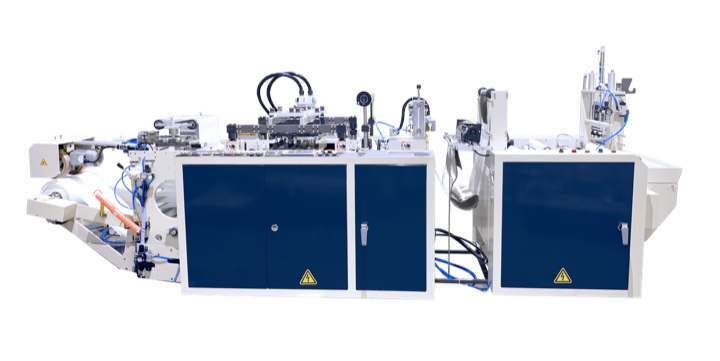
COSMO's model in this category is the SSCR-50-L1+BUB, a single-line air column and cushion bag making machine. The finished cushioning has independent air chambers and can be torn by hand along perforations into shorter sections to suit packing needs.
Applications include e-commerce fulfillment and express courier packaging for fragile, high-value items such as wine bottles, cosmetics, milk powder tins, and consumer electronics. These products may require cushioning that fits around the item.
COSMO uses a large heated plate to press and heat-seal a pattern into semi-finished bag material. This method produces cushioning with more small air chambers. Conventional sealing is also available, depending on customer requirements.
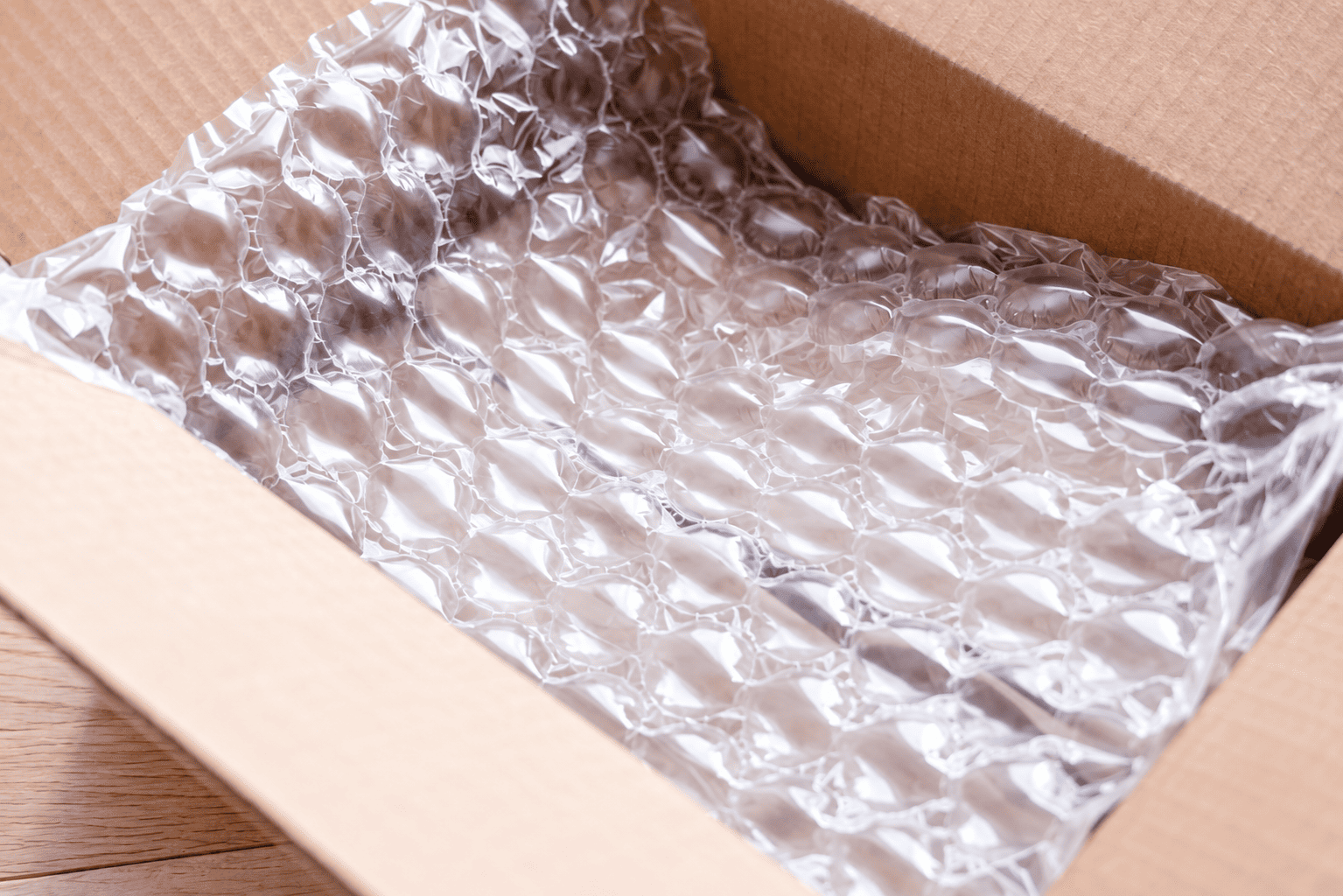
Cushioning with multiple small air chambers, produced using a heated patterned plate.
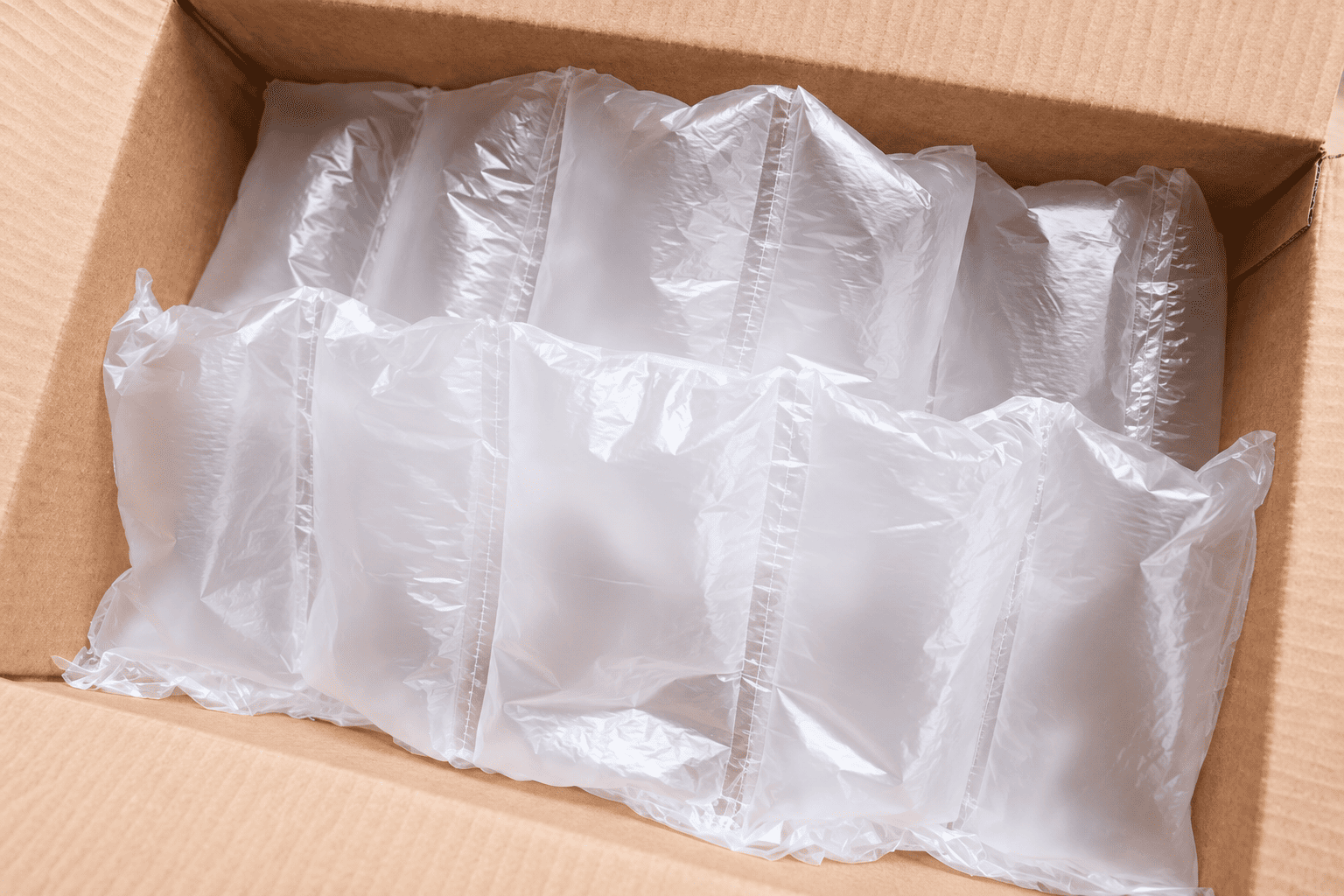
Cushioning produced using conventional sealing.
| Specification | Value |
|---|---|
| Production length | 300 mm (determined by mold size) |
| Production width | 450 mm (maximum) |
| Film thickness range | 0.008–0.05 mm |
| Production speed | 80 meters/min/line |
| Film roll size | Max Ø900 × 450 mm |
| Power requirements | 220V, 3-phase, 50/60 Hz, 20 KVA |
| Heater capacity | 14–18 KW (determined by mold size) |
| Dimensions (L × W × H) | 4900 × 1150 × 1700 mm |
| Required air compressor | 10 HP (not included) |
Key Performance Features:
The SSCR-50-L1+BUB includes the following production and control features:
- End-to-end automation: raw film rolls to finished, sealed bags in one continuous workflow, with no intermediate handling station to staff.
- On-machine adjustment: bag length and production speed are set directly on the interface, so a size change does not require a mechanic.
- Automatic stop protection: the machine halts on film runout, blocked film feed, or bag jam — the three conditions that otherwise run a full roll into scrap before anyone notices.
FAQ
How long do air column bags stay inflated?
There is no single retention period that applies to all air column bags. Air retention time depends on film quality, thickness, seal precision, inflation pressure, and storage conditions. Ask your supplier for pressure-retention test reports specific to the film blend and thickness you plan to use.
Are air column and air cushion bags recyclable?
They can be recyclable, depending on film composition and local collection options. Many air column and air cushion bags are made from polyethylene (PE) film. Confirm the film specifications with your supplier and check whether suitable recycling services are available in the destination market.
Confirm the Seal Before You Confirm the Order
When comparing air column bag making machines, check film compatibility, production speed, sealing technology, and chamber independence against your intended bag format. For products that use valves, confirm the valve design and available air-retention checks with the supplier.
Get a personalized quote today, or send your product dimensions and air cushion bag requirements to COSMO to discuss the SSCR-50-L1+BUB, mold configuration, and sealing options.